Merchant · Strategy & Growth
Beyond the GHS 15 Bucket: Strategic Marketing Lessons from KFC Ghana’s 15-Year Milestone
What KFC Ghana’s 15th-anniversary promotion teaches Ghanaian businesses about memorable pricing, customer participation, operational readiness and protecting long-term brand equity.
Fifteen years. Fifteen cedis. One big celebration.
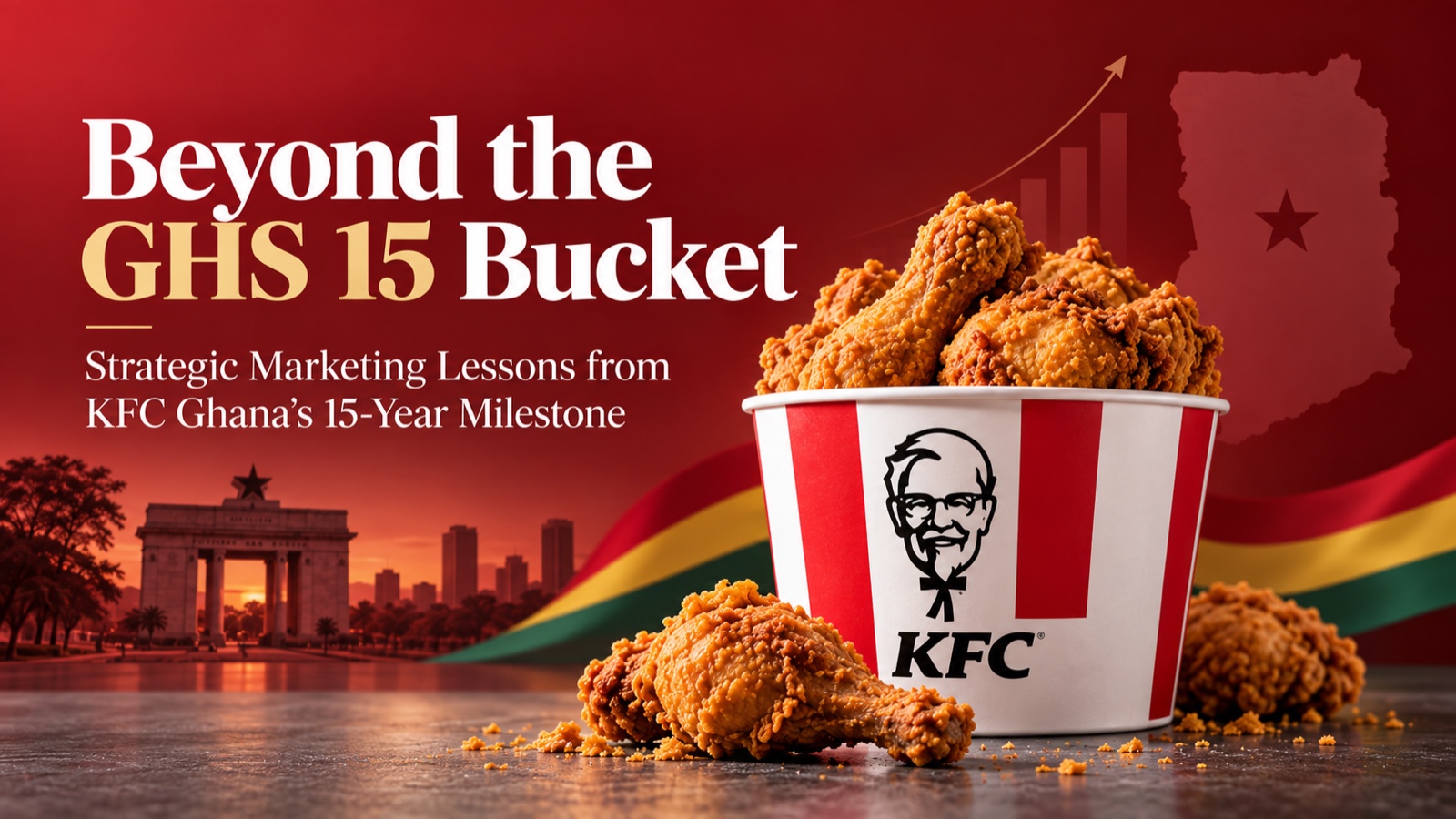
On 15 August 2026, KFC Ghana marked exactly 15 years since opening its first restaurant in Osu with a one-day GH₵15 anniversary deal. The meal included one piece of chicken, two tenders and small chips, and was promoted nationwide from 9 a.m. to 5 p.m.
The idea was remarkably simple: 15 years. GH₵15.
And consumers responded.
Long queues appeared at KFC branches around the country. At some locations, the crowds became difficult to manage, with reports of overcrowding and security interventions.
That makes the campaign more interesting than a simple story about a successful discount.
For Ghanaian entrepreneurs, retailers, restaurant operators and marketers, KFC Ghana’s anniversary offers lessons on both sides of growth: how a powerful value proposition can move consumers at scale — and why marketing cannot be separated from operations.
At a glance
Key Takeaways
- Keep promotional value propositions simple.
- Make customers participants in the milestone.
- Stress-test operations before creating demand.
- Use limited promotions without resetting long-term price expectations.
Lesson 1: Make the Value Proposition Impossible to Misunderstand
The strongest feature of the campaign was its cognitive simplicity.
KFC did not ask customers to calculate a percentage discount, accumulate loyalty points, enter a promotional code or meet a complicated spending threshold.
The proposition could be communicated almost instantly:
15 years. GH₵15.
That numerical symmetry matters.
The anniversary was not merely the reason for the campaign; the number itself became part of the offer. That makes the message easier to remember, easier to share and easier for customers to explain to other people.
For local brands, the lesson is not to copy GH₵15 pricing. It is to create offers that customers can remember without seeing the advertisement twice.
A café celebrating five years might offer a GH₵5 add-on. A retailer celebrating 10 years could offer a 10% loyalty reward for a limited period.
The test is simple:
Can a customer explain your promotion correctly in one sentence?
If not, simplify it.
Lesson 2: Turn the Milestone Into Customer Value
Anniversary marketing can easily become a corporate vanity exercise.
There are the congratulatory newspaper ads, executives cutting cakes, corporate speeches and billboards telling customers how successful the company has become.
The problem is that customers rarely care about a corporate anniversary as much as the company does.
They care about what that milestone means for them.
KFC translated its longevity into an immediate customer benefit. Consumers were not simply being asked to celebrate 15 years of KFC Ghana. They were given a reason to participate in the celebration.
That changes the customer from an audience member into a participant.
For Ghanaian businesses, this is especially important when consumers are highly conscious of value.
Customer appreciation does not always have to mean a dramatic price reduction. It can take the form of free delivery, loyalty credit, an extra product, priority access, a useful upgrade or an exclusive bundle.
The principle remains the same:
If customers helped you reach the milestone, make sure they can feel the celebration too.
Lesson 3: Marketing Success Can Become an Operational Failure
The same thing that made the KFC promotion powerful also created its biggest risk:
Demand.
The GH₵15 offer attracted enormous attention. Reports documented long queues and overcrowding at multiple branches, with security intervention required at some locations.
We do not have KFC Ghana's internal sales, profitability or retention data, so it would be premature to call the campaign a complete commercial success.
What we can observe is that it was extremely effective at getting people to act.
And that is where marketing strategy must meet operations strategy.
Before launching a high-demand promotion, businesses should ask:
- What happens if demand is twice our normal peak?
- How quickly can the promotional product be fulfilled?
- Where will customers queue?
- What happens if Mobile Money or card processing slows down?
- What happens when a location reaches capacity?
- How will customers be informed if stock runs out?
The same principle applies to digital companies.
A successful campaign can overwhelm servers, customer-support teams, payment systems or delivery capacity just as easily as it can overwhelm a restaurant counter.
The lesson is not to avoid ambitious promotions.
It is to never create demand you have not designed the business to fulfil.
Lesson 4: Discount Without Damaging Brand Equity
Discounting can be powerful, but it can also train customers to wait for the next promotion.
KFC had one important protection: the GH₵15 offer was tied to a specific milestone and a clearly limited window.
That creates a different psychological frame from permanent discounting.
The lower price becomes a celebration, rather than a new reference price for the product.
Growing brands should use the same discipline.
Keep major promotional discounts time-bound. Limit them to a defined hero product or bundle. Make the reason for the exceptional value obvious.
Most importantly, do not judge success by queues or social-media impressions alone.
A crowded store does not automatically mean a profitable campaign.
Businesses should ask:
- How many new customers did we acquire?
- What happened to contribution margin?
- What was the average basket value?
- How many customers returned within 30 or 60 days?
- What happened to customer sentiment?
- Did operational complaints damage any of the brand value we gained?
The objective is not cheap volume.
It is profitable attention that can become long-term demand.
A 4-Step Milestone Campaign Playbook for Ghanaian Brands
1. Engineer one memorable value anchor
Connect the milestone to one simple offer customers can understand and share instantly.
2. Stress-test operations before publishing
Model demand spikes across inventory, staffing, payments, technology, delivery capacity and customer flow before the first advertisement goes live.
3. Synchronise every customer touchpoint
Your social posts, website, in-store signage, staff communication and checkout systems should communicate the same offer and conditions.
4. Measure what happens after the promotion
Track acquisition, basket economics, complaints, repeat purchases and retention.
The real value of a milestone campaign is not what happens during the promotion.
It is what remains when the promotion ends.
The Bigger Lesson From KFC Ghana at 15
KFC Ghana’s anniversary demonstrates that great marketing is not simply communication.
It is the intersection of pricing, consumer psychology, distribution, customer experience and operational execution.
The GH₵15 deal succeeded spectacularly at one thing we can clearly observe: it captured attention and moved people to act.
The operational pressure that followed is equally instructive.
For growing Ghanaian businesses, that combination is the real case study.
Build an offer simple enough to travel through word of mouth. Make it valuable enough to change customer behaviour. Then build the operational capacity to deliver the promise when everyone actually shows up.
Because the best campaign is not the one everyone talks about for one day.
It is the one that turns a moment of attention into years of customer value.
Sources and further reading
Campaign details and crowd reports are drawn from publicly available material. Strategic conclusions are GoBites’ independent analysis.
GoBites Growth
Planning your next growth campaign?
Download our 4-Step Milestone Campaign Checklist or subscribe to the GoBites growth newsletter for practical breakdowns of retail, restaurant and marketing strategies across Ghana. Explore how GoBites supports merchants or learn about GoBites.